
Do you need to be able to programme in order to automate processes?
Do you need to know how to programme to automate business processes? Find out how low-code works with CAS and how staff and developers work together.
3 mins’ read time
In this article
You know exactly how a business process works. You’re familiar with the exceptions, the checks and the steps that need to be carried out. But does that also mean you need to be able to programme in order to automate that process?
Not necessarily.
With low-code platforms such as Clickker Automation Suite (CAS), business processes can be built visually.
Nevertheless, there is a significant difference between understanding a process and implementing it technically.
What does ‘low-code’ actually mean?
‘Low-code’ means that software development is largely carried out using visual building blocks rather than solely through programming code.
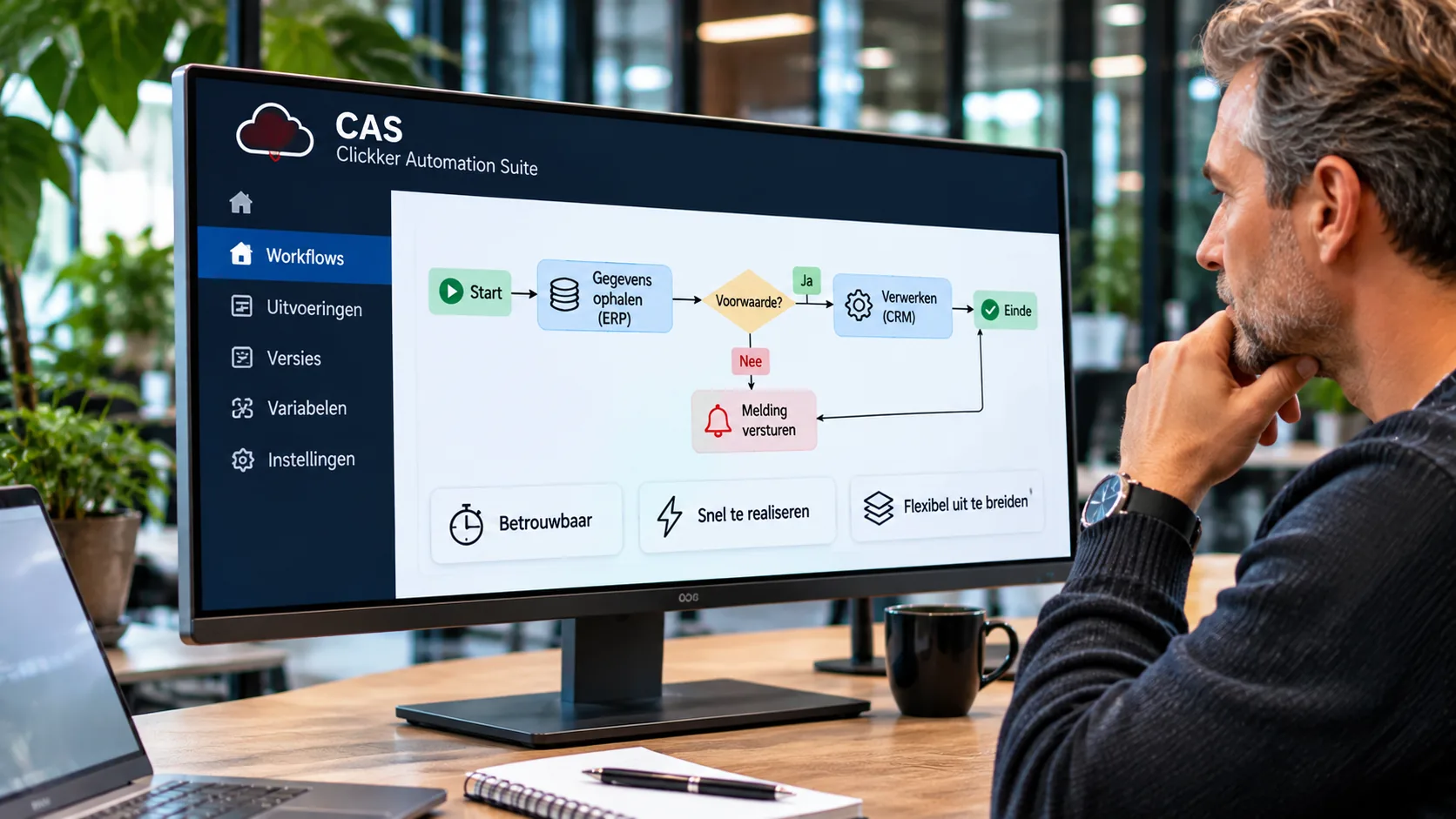
Within CAS, a workflow consists of individual activities.
For example, an activity might retrieve data, carry out a check or send information to another application.
By linking activities together, an automated process is created.
This makes it easier to understand how an automated system works, even for staff who do not programme on a daily basis.
From business process to workflow
Suppose an employee knows exactly which checks need to be carried out before product details can be amended.
That member of staff can describe the desired process in functional terms.
For example:
- Retrieve the relevant articles.
- Please check that the details meet the requirements.
- Please correct any discrepancies.
- Save the changes back to the ERP system.
- Please record any errors.
The technical implementation can then be carried out by an application administrator, developer or integration specialist.
In this way, the substantive knowledge remains with the staff who are familiar with the process, whilst the technical implementation is carried out by people with the relevant expertise.
What can you do without any programming knowledge?
CAS offers a range of standard functions that can be used to retrieve, process and forward data.
Existing workflows can also be used as reusable activities.
This means that not every stage of the process needs to be developed from scratch.
For staff who are familiar with how applications and data flows work, these visual building blocks can help them to understand and manage automations.
When is technical knowledge required?
Not every data processing task can be configured entirely via visual settings.
JavaScript may be required within CAS for specific data changes or more complex business rules.
Consider updating multiple data fields, performing calculations or handling exceptions.
It is also important to know which technical data fields are associated with the application in question.
CAS provides support with writing code, but does not eliminate the need for all technical knowledge.
Collaboration between the business and IT
It is precisely the collaboration between operational staff and technical specialists that can yield significant benefits.
The operational staff member knows what needs to be done.
The technical specialist knows how the data is made available and what processing is required for this.
As the workflow is structured visually, it is easier for both parties to discuss which steps are to be carried out.
This means that changes to the business process can be discussed in more concrete terms than if the entire logic were hidden within the programme code.
Develop it yourself or have it done for you?
Not every organisation has the same needs.
Some companies have application administrators or developers who want to build automation solutions themselves.
Other organisations are primarily concerned with ensuring that their processes run smoothly, without being responsible for the technical development themselves.
Sense Cloud supports both methods.
We can help implement workflows, but we can also work alongside staff who wish to carry out part of the management or development themselves.
Automation starts with an understanding of the process
You don’t always need to be able to programme yourself to make a valuable contribution to process automation.
Often, the most important first step is to know exactly what work is to be carried out, why it is necessary and under what conditions it will take place.
On that basis, a suitable technical solution can be developed.
Do you want to automate processes, but lacks the technical expertise within your organisation?
Sense Cloud is keen to work with you to develop a practical approach that combines your process knowledge with our technical expertise.
