Converting Orbis tasks

Converting Orbis to a REST API

Maintain your business processes. Modernise the technology behind them.

Do you use Orbis within Exact Globe Next or Globe+? Sense Cloud helps you migrate existing Orbis tasks to a modern REST API architecture, whilst retaining your process logic and utilising documented and reusable API functionality.

  • Review of existing tasks

  • Seamless conversion to REST API

  • Fully documented

Modernising integrations

Your Orbis processes are working. Why would you want to change them?

Orbis has been used for many years to automate business processes relating to Exact. These include processing sales orders, amending invoices, updating product data and carrying out logistics operations. Many of these automated processes work very well and deliver value on a daily basis. Nevertheless, there may be reasons to reassess technical arrangements, such as:

  • Less dependence

  • Greater insight and control

  • A modern REST API as part of a best-of-breed strategy

  • Greater reusability

  • Ready for Globe+

A business process that works well does not need to be changed simply to modernise the technology behind it.

What changes are there from a technical point of view?

From existing Orbis automation systems to a REST API architecture

An Orbis task may consist of several steps. An event triggers a process; data is retrieved and checked, after which any changes are processed in Exact. Additional actions may then take place.

In a modern REST API architecture, we distinguish between two components.

Current situation

Triggers, conditions, checks, data processing and process automation.

New situation

Integration flows
The existing process logic, controls and automation steps are being reorganised.

REST API
The required data and functionalities of Exact are made available via standardised API endpoints.

Options

Which Orbis tasks can be converted?

Many existing automation processes relating to Exact may be suitable for migration to a REST API-based architecture.

Financial automation

Amending invoice details, changing invoice types, collating invoices and carrying out administrative tasks.

Order processing

The creation, updating and correction of sales orders and order lines, including associated checks and exceptions.

Logistics processes

Automation relating to warehouses, stock movements, deliveries and item/warehouse links.

Process-dependent automations

Processes involving multiple steps, triggers, conditions, data operations and follow-up actions.

Not every Orbis task can be transferred one-to-one without modifications.
The possibilities depend on the existing process logic, the available API functionality and any dependencies between processes.
That is why a successful migration begins with a thorough assessment.

Our services

From analysis to implementation.

Reliable integration starts with an understanding of your systems and processes.
Our specialists will guide you every step of the way, from the initial assessment right through to technical implementation. We’ll set out clear agreements regarding the work to be carried out, the expected results and the costs.

Step 1

Stock-taking

We will carry out a review of your existing automation systems.

Which Orbis tasks are active? Which business processes do they support? And how are the automated systems structured?

We are investigating the triggers, conditions, data operations, exceptions and interdependencies.

The available documentation forms the starting point for this.

Step 2

Technical assessment

We determine what is required to re-execute the existing processes.

Our specialists assess which Exact functionality is available via existing REST API endpoints and where additional functionality is required.

We are also investigating which automation processes are interdependent and which migration sequence is most appropriate.

Step 3

Transposition

We are redesigning the existing process logic.

The Orbis tasks are mapped to integration flows whilst retaining the necessary checks, conditions and data processing operations.

Where possible, we use existing, reusable API functionality.

Step 4

Testing and validation

We’re checking that the new automations are doing what they’re supposed to.

The implemented processes are tested on the basis of their existing functionality.

Together, we will review the results and discuss any discrepancies before the new automated processes are put into operation.

Controlled commissioning
We are carefully replacing existing automated systems.
Following functional acceptance, the new integration flows will be activated.
The relevant Orbis tasks are checked and deactivated in consultation.
This is how we minimise the risks to day-to-day operations.

Technology from Sense Cloud.

Where Exact’s standard features end, we go a step further.

We don’t build every integration from scratch. Sense Cloud has developed its own technology for unlocking data, connecting applications, and automating processes around Exact.


The dedicated API for Exact software

Unlock Exact. Connect any application.
The Clickker API makes data and functionality from Exact accessible to other API applications. This creates a reliable foundation for integrations between Exact and other applications.

Discover Clickker →

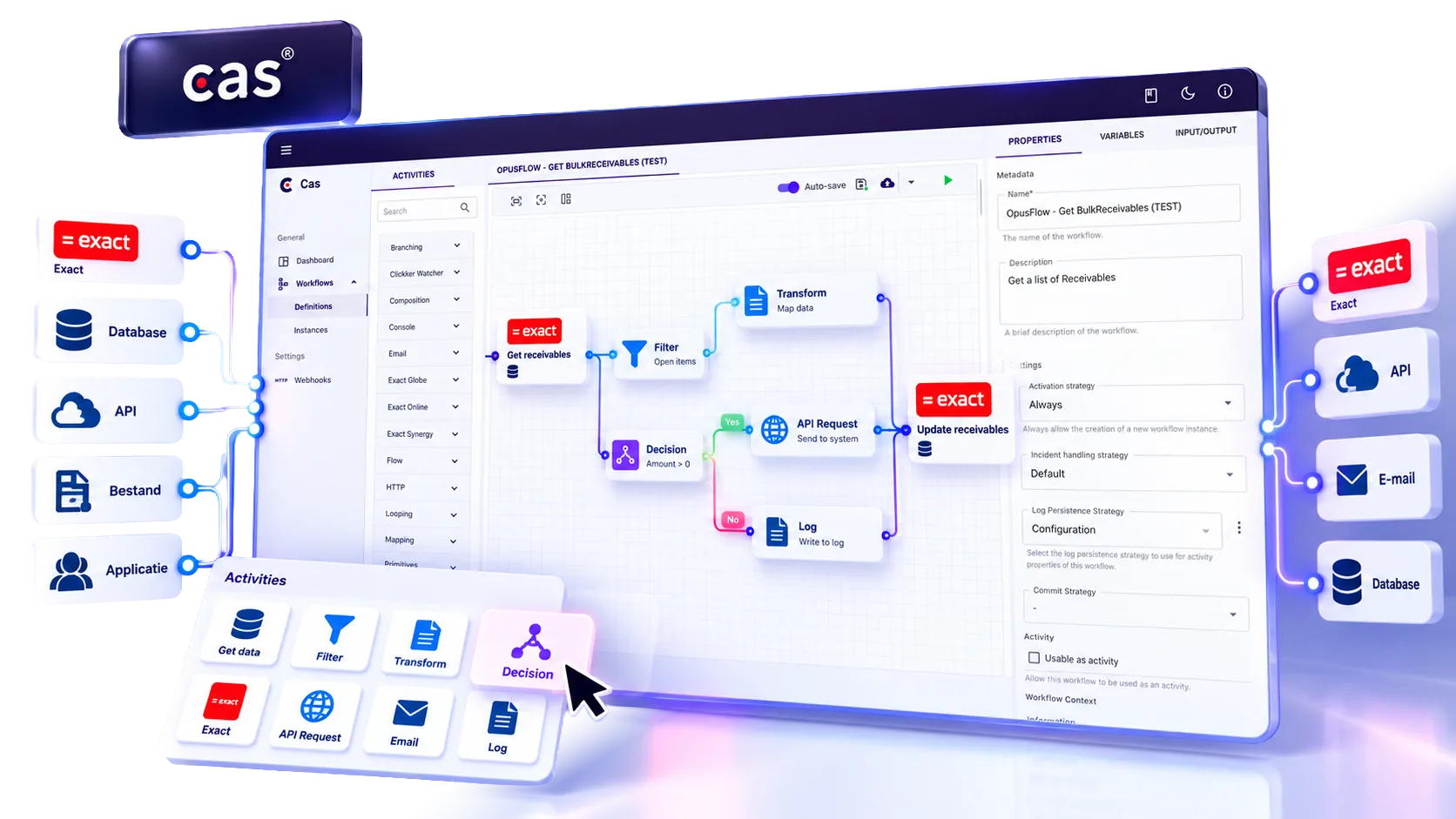
Visual drag-and-drop flow builder

Automate processes across systems.

CAS connects applications in automated workflows. From triggers and decision rules to actions, controls, and follow-up: processes run automatically.

Discover CAS →

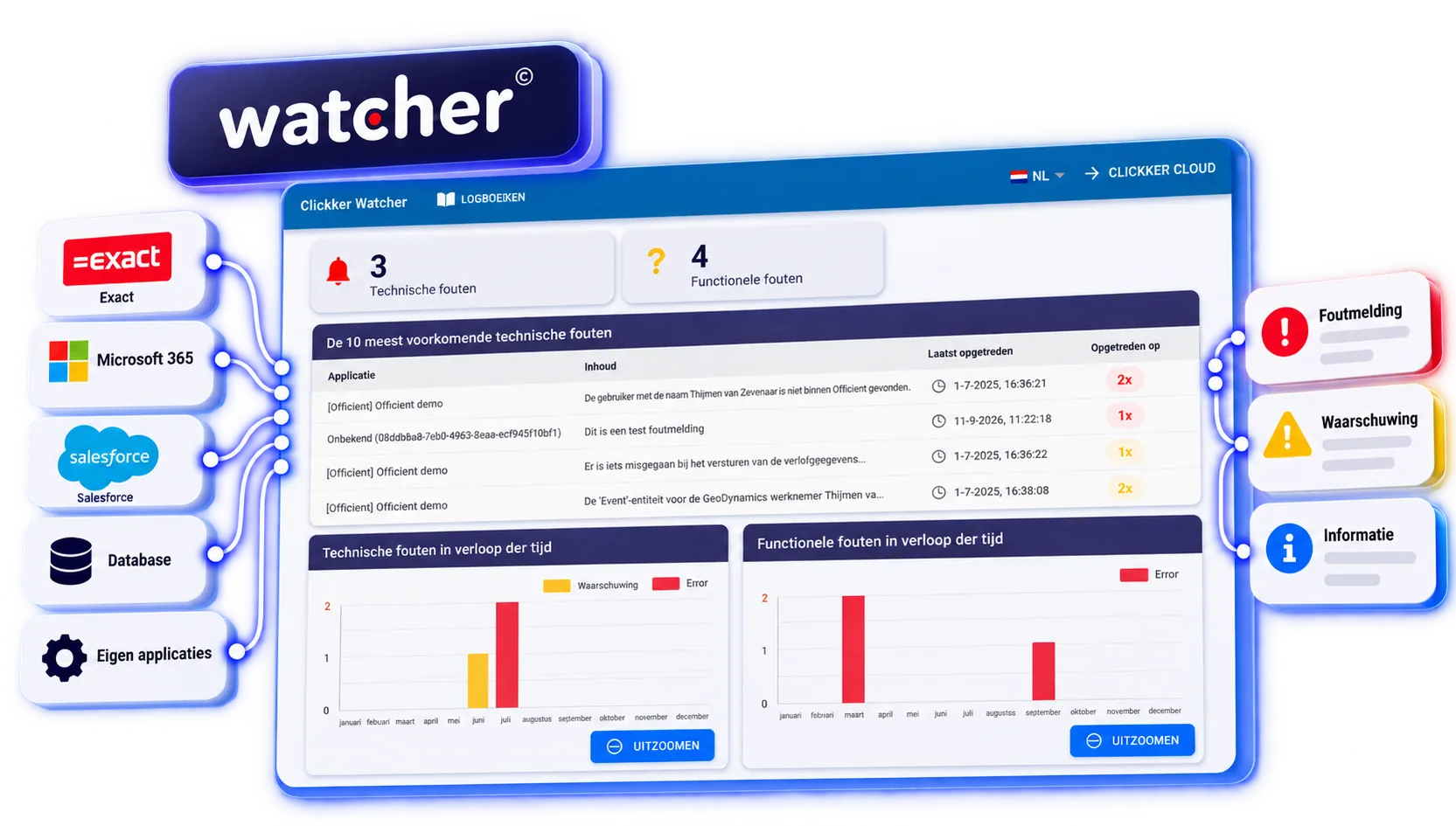
Monitoring & logging interface

Know what is happening. Act when necessary.

Watcher monitors processes and signals when something deviates or needs attention. This way you stay in control of automated processes and integrations.

Discover Watcher →

Frequently Asked Questions

Want a quick answer to your question?

The investment varies from organisation to organisation and depends not only on the number of Orbis tasks, but above all on the complexity of the automation processes.

The key factors are the existing process logic, the available documentation, the existing REST API functionality, any additional endpoints that may be required, and the testing work.

That is why we are starting with a needs assessment. Based on this, you will receive a detailed estimate of the work involved and the investment required.

No fixed price per task, but a bespoke proposal.

No. Orbis is used to automate business processes. A REST API makes an application’s data and functionality accessible to other software.

To replace existing Orbis automations, both REST API access to Exact and an environment for executing the process logic are usually required.

No. A phased migration is possible.

Which tasks are implemented first depends on their interdependencies, technical complexity and their importance to your business operations.

That is the starting point. We map out the current process flow and reconfigure the automation systems whilst retaining the necessary business logic, checks and exceptions.

We will discuss any process improvements or functional changes separately.

Not necessarily. During the technical assessment, we will examine which Exact functionality is already available via REST API endpoints and which additional functionality may need to be developed.

This will give you an understanding of the technical possibilities and the work required in advance.

Yes. Sense Cloud can assess existing Orbis automations and, where technically feasible, convert them to a REST API-based integration architecture for Exact Globe Next and Globe+.

The work required will depend on your Exact configuration and the existing automation systems.

No, that isn’t necessary. However, having the relevant documentation does help to assess the migration more quickly and effectively.

Where documentation is missing or out of date, we first investigate how the existing automated systems actually work.

In many cases, yes. A phased transition makes it possible to keep existing Orbis tasks active until the replacement systems have been tested and approved.

We tailor the exact approach to the interdependencies and the risks to your business operations.

We are happy to help you

Looking to modernise your Orbis automation systems?

Keep what works well. Modernise what could be improved.

Does your organisation have any existing Orbis automation systems within Exact Globe Next or Globe+?

Sense Cloud helps you to take stock of your current processes, assess the technical possibilities and develop a suitable migration strategy.

This allows you to retain the business processes that are important to your organisation, whilst at the same time laying a reusable technical foundation for future integrations.